Updates
Why Schools Are Switching Away From Physical Phone Policies
Nov 18, 2025
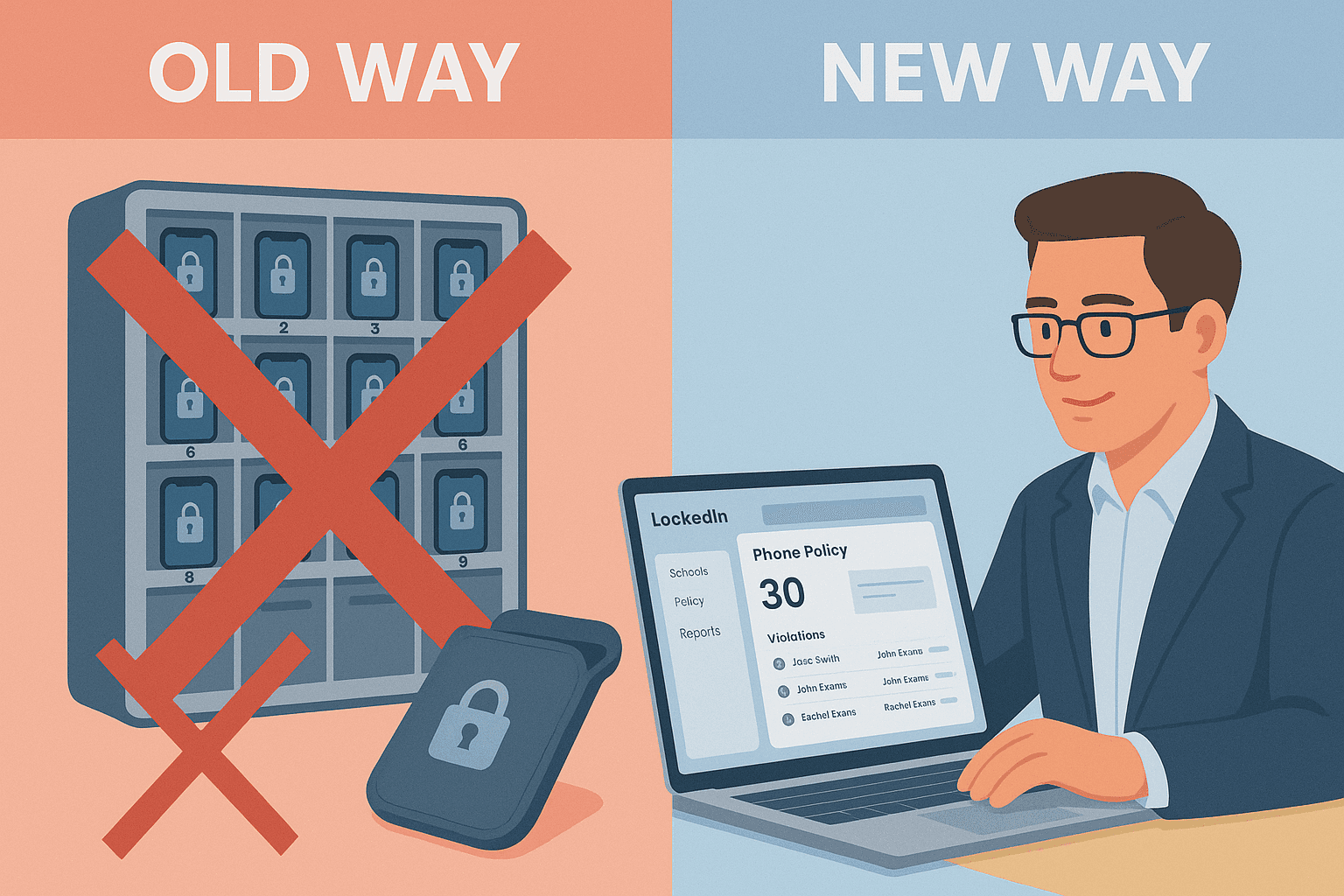
Why Schools Are Switching Away From Physical Phone Policies
If you walk into almost any middle or high school today, you see the same scene. Teachers trying to teach, students trying to focus, and smartphones trying to steal the show.
For years, schools have tried to control phones with physical solutions like baskets, lockers, and pouches. At first they seemed like an easy fix. Now, more and more schools are quietly moving away from those policies and looking for digital phone management instead.
This article explains why physical phone policies are breaking down, what is replacing them, and how a tool like LockedIn can give your school a modern, realistic phone policy that actually works.
What are “physical phone policies” in schools
Physical phone policies are any rules that rely on hardware or manual collection to control devices, such as:
Phone pouches that get locked at the door
Cell phone lockers in hallways or classrooms
Baskets or caddies where students drop phones at the start of class
Front office collection of phones for the entire day
All of these have the same idea. Take the phone out of the student’s hand and keep it somewhere else so they cannot use it. On paper, that sounds simple. In real schools, it creates new problems that are pushing leaders to rethink their approach.
Why schools are moving away from physical phone policies
They are expensive to start and hard to maintain
Phone pouches, wall mounted lockers, and large storage systems all require a big upfront purchase. Then come the hidden costs.
Lost or damaged pouches that need replacements
Locker keys that go missing
Caddies that break
Staff time spent handing out, collecting, and tracking devices
Over a few years, a “one time” purchase can turn into an ongoing cost that does not match the impact you hoped for.
They put a heavy burden on teachers and front office staff
Physical systems only work if adults actively run them. That means:
Standing at the door every period to collect or check phones
Unlocking pouches or lockers at the end of the day
Dealing with students who arrive late or forget the rules
Managing exceptions for students who need access because of health or family situations
Teachers did not sign up to be security guards. When your phone policy depends on them manually checking every device, it eats into the time and energy they need for instruction and relationships.
Students find ways around physical controls
Students are creative. If there is a physical system, they will test it. In many schools, you see things like:
Old phones kept in pouches while the real phone stays hidden
Pouches opened with magnets or force
Phones left out of baskets after the teacher turns to the board
Friends texting from each other’s devices to avoid being caught
The result is a lot of adult effort with inconsistent results. Some students follow the rules. Others quietly do not. That leads to more conflict and more claims of unfairness.
Physical policies ignore how families actually communicate
Parents are used to texting their kids about pickup, work schedule changes, and everyday logistics. They also want to know their child can reach them during a real emergency.
When a phone is locked in a pouch or stuffed in a cabinet in the office, it is basically off the grid all day. That feels outdated to many families and creates friction between home and school.
There is no data and no visibility
With pouches, lockers, and baskets, you might know that phones are “away” at the start of class. You do not know much else.
You cannot see:
Who keeps breaking the rules
What times of day see the most violations
Whether your policy is getting better or worse over time
That means every conversation with a student or parent is based on memory and emotion instead of clear information.
Why digital phone management is replacing physical policies
A growing number of schools are switching from “collect the device” to “control how the device is used.” Instead of storing phones in a physical place, they use a phone management app that locks devices during the school day and tracks violations automatically.
This shift solves many of the problems above.
Consistent enforcement without constant confrontation
Digital phone systems apply the same rules to every student once the day begins. If a student uses their phone during a restricted time, the system logs it and notifies staff.
Teachers do not have to patrol every pocket. They can focus on teaching, knowing that there is a clear, consistent structure backing them up.
Lower total cost over time
A software subscription often costs less per student per year than physical pouches or lockers, especially when you include replacement hardware and staff time.
You do not pay for construction, special keys, or magnets. You pay for a service that updates and improves without buying another set of hardware.
Better safety and parent communication
In a digital model, students still physically have their phones, but the devices are locked for most of the day. In a true emergency, they can access their phone and the system records that use.
This balances safety and control. Parents know their child is not scrolling TikTok in algebra, but they also know that phone access is not completely cut off if something serious happens.
Real data for better decisions
Because everything runs through the app and dashboard, administrators can see patterns.
You can track:
Which grades or classes have the most violations
Which times of day are hardest for students
Whether a new policy or assembly actually changes behavior
That turns your phone policy from guesswork into something you can measure and improve.
A better student experience
When students understand the rules, see that they are applied fairly, and still feel treated like young adults, they are much more likely to buy in.
A digital phone policy can:
Allow controlled use at lunch or after school
Respect accommodations for students who need access for health reasons
Make expectations predictable instead of random teacher by teacher rules
Students might not love giving up their phones during class, but they are far more willing to accept a system that is clear, consistent, and not humiliating.
What a modern phone policy looks like with LockedIn
LockedIn is built to give schools all of the advantages of digital phone management without the stress of physical hardware. Unlike Yondr, LockedIn is a digital solution that keeps students safe without taking away ownership of their phones.
Here is how it works in practice:
Students arrive on campus and open the LockedIn app. With a few taps, they lock their phone for the school day.
The app uses location and other signals to make sure the device stays in locked mode during restricted times.
If a student tries to use their phone when they should not, LockedIn records a violation and alerts staff through a simple dashboard.
During approved windows like lunch, passing periods, or after school, you can allow phone use again without confusion.
For administrators and teachers, this means:
Less time fighting phones and more time teaching
A clear log of violations for parent meetings and support plans
Flexible settings for different grade levels or campuses
A fair system that applies to every student, not just the ones who got caught with their device out
For families, it means:
Confidence that the school has a real plan for phone distraction
Assurance that their child can still reach them if something important happens
Fewer daily battles over devices at home because the school day already has structure
For students, it means:
A calmer classroom environment
Fewer “gotcha” moments and public call outs
The ability to focus during class and then use their phone at appropriate times
Why now is the time to move past physical phone policies
Phone distraction is not going away. Laws, parent expectations, and student habits are all moving in the same direction. Schools need a solution that is serious, scalable, and sustainable.
Physical phone policies were a first step. They made it clear that the old “just keep it in your backpack” approach was not enough. But as schools see the costs, friction, and loopholes, they are looking for something better.
Digital phone management with LockedIn gives you that next step. It takes your existing rules and turns them into a living system that supports your staff, respects your families, and helps students learn how to live with their devices in a healthier way.
If your school is ready to move away from physical phone policies, now is the perfect time to explore what a digital approach can do. Reach out to LockedIn to learn more, see a demo, and start building a phone policy that finally works in the real world.
